
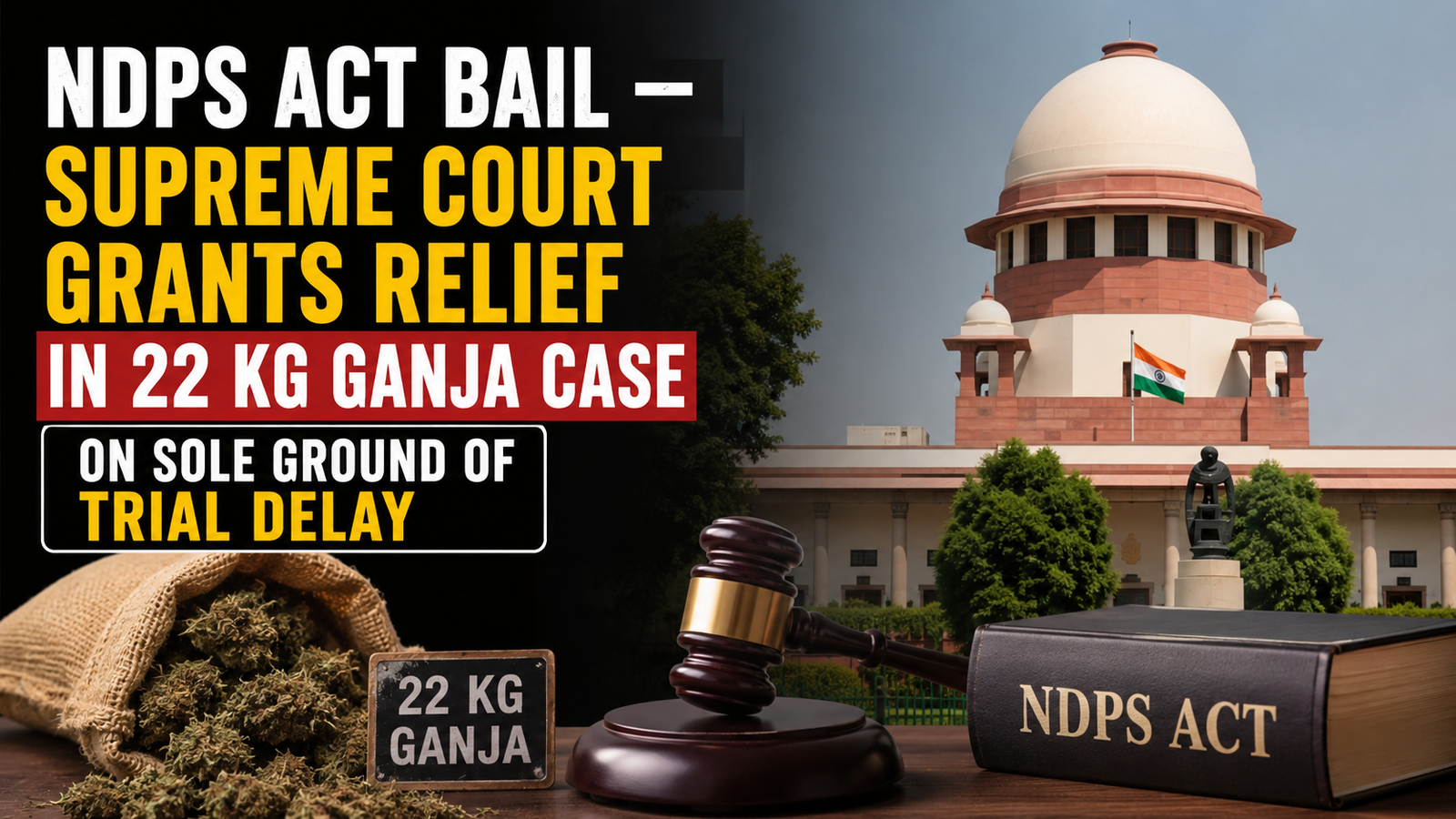
Supreme Court Grants Bail In 22 KG Ganja Case Solely On Ground Of Trial Delay
A Rare Instance Of Bail Overriding The NDPS Act’s Strict Bar
The Supreme Court of India has granted regular bail to a man accused of possessing nearly 22 kilograms of ganja, resting its decision on a single factor: the glacial pace of his trial. The ruling, delivered on May 5, 2026, in Rajadurai vs. The State of Tamil Nadu [SLP(Crl.) No. 4729/2026, reported as 2026 LiveLaw (SC) 462], is significant because narcotics offences involving commercial quantities are ordinarily among the hardest categories in which to secure bail under Indian law.
What The Case Was About
The petitioner, Rajadurai, was booked under Sections 8(c), 20(b)(ii)(c), and 29(1) of the Narcotic Drugs and Psychotropic Substances Act, 1985 (NDPS Act) — provisions dealing with possession, sale or purchase of a commercial quantity of a narcotic drug, and criminal conspiracy connected to it. Because the quantity involved fell within the “commercial quantity” bracket, the case attracted the heightened bail threshold under Section 37 of the NDPS Act, one of the toughest bail regimes in the Indian statute book.
The Madras High Court had already turned down his plea for regular bail, prompting him to approach the Supreme Court through a Special Leave Petition.
The Supreme Court’s Reasoning
A bench of Justice J.B. Pardiwala and Justice K.V. Viswanathan heard the matter and was told that Rajadurai had already spent more than a year in judicial custody. What appears to have tipped the scales in his favour was the state of the trial itself: even though the trial court had formally framed charges, not a single witness had been examined in all that time.
The bench recorded its satisfaction in a brief but pointed observation, noting that despite the framing of charge, not a single witness has been examined and that, in the circumstances, it was persuaded to exercise its discretion in the petitioner’s favour. The order, running to about four pages, directed that he be released on bail forthwith, subject to conditions the trial court considers appropriate.
Why This Verdict Stands Out
Bail under the NDPS Act is not granted lightly. Section 37 requires a court to be satisfied of two conditions before releasing an accused involved in a commercial quantity case:
- There are reasonable grounds to believe the accused is not guilty of the offence, and
- The accused is unlikely to commit any offence while on bail.
These “twin conditions” have traditionally made bail in large-quantity narcotics cases an uphill task, since courts must record a positive finding on both counts — not merely note delay or hardship. In Rajadurai’s case, the Supreme Court appears to have leaned on the accused’s fundamental right to a speedy trial under Article 21 of the Constitution as a countervailing force strong enough to justify bail, even without a detailed finding on the twin conditions.
A Sharp Contrast With A Recent Precedent
The ruling stands in notable tension with another recent Supreme Court decision on the very same question. In State of Punjab v. Sukhwinder Singh @ Gora [2026 LiveLaw (SC) 421], a bench led by Justice Sanjay Karol took the opposite view. That bench set aside a Punjab and Haryana High Court order which had granted bail purely on account of trial delay, holding that the right to a speedy trial cannot be used to bypass the stringent statutory conditions under Section 37 of the NDPS Act, particularly in commercial-quantity cases.
The juxtaposition of these two rulings — delivered within weeks of each other by different benches of the same court — highlights an unsettled tension in Indian bail jurisprudence: how much weight should Article 21’s promise of a speedy trial carry against a statute that Parliament deliberately made restrictive to curb narcotics trafficking?
What This Could Mean Going Forward
Lower courts and defence lawyers across the country are likely to invoke the Rajadurai ruling in similar situations — where an accused has been incarcerated for a prolonged period under NDPS charges but the prosecution has made little or no headway in producing evidence or examining witnesses. At the same time, prosecutors and courts wary of setting a precedent that dilutes Section 37 will likely point to the Sukhwinder Singh ruling to argue that delay alone cannot be a backdoor route to bail in serious narcotics cases.
Until a larger bench of the Supreme Court authoritatively reconciles these two lines of reasoning, trial courts and High Courts are left to navigate a genuine doctrinal split — one where the outcome for an undertrial in a commercial-quantity NDPS case may depend significantly on which precedent is cited, and before which bench the matter is argued.
Key Takeaways For Readers
- The Supreme Court granted bail in a case involving nearly 22 kg of ganja, a commercial quantity under the NDPS Act.
- The sole ground cited was prolonged trial delay — over a year in custody with no witnesses examined despite charges being framed.
- This appears to conflict with a separate recent ruling (State of Punjab v. Sukhwinder Singh @ Gora) that held trial delay cannot override Section 37’s twin conditions.
- The case underscores an ongoing tension between an undertrial’s right to a speedy trial and the strict bail bar Parliament built into narcotics law.
This article is based on the Supreme Court’s order dated May 5, 2026, in SLP(Crl.) No. 4729/2026, and publicly reported case coverage. It is intended for general legal awareness and does not constitute legal advice.