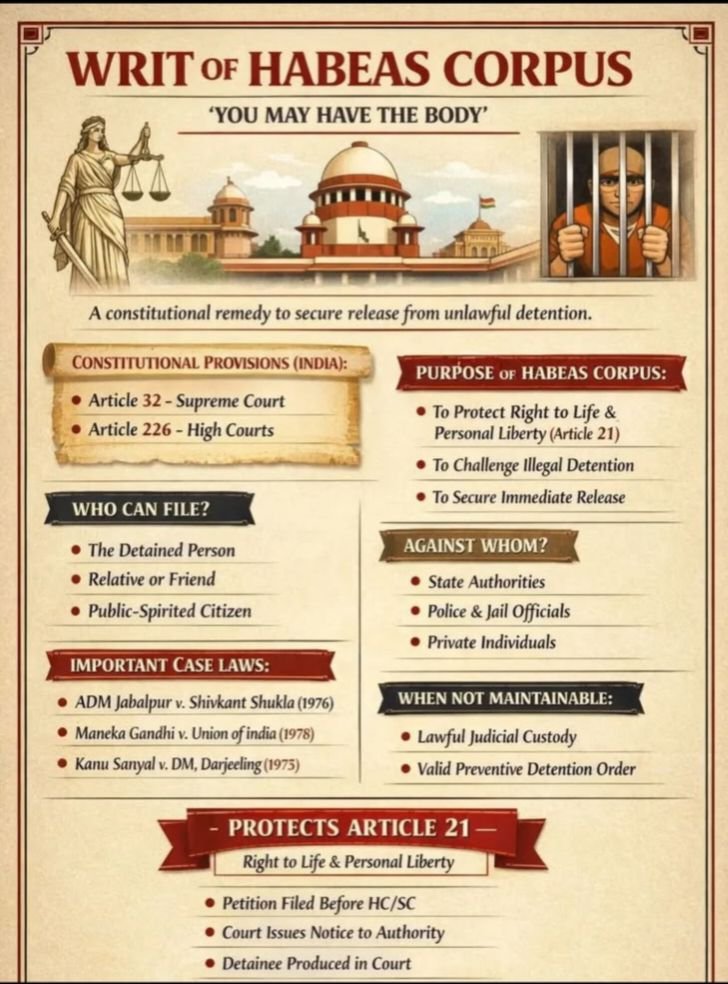
Imagine you’re arrested without reason, locked away in the dead of night, with no charges or trial in sight. In India, the Writ of Habeas Corpus steps in as your constitutional knight in shining armor. Latin for “you shall have the body,” this ancient writ compels authorities to produce a detainee before a court and justify the detention. If they can’t, release is immediate.
Rooted in English common law from the 13th century, it arrived in India via the Magna Carta’s spirit. Today, it’s enshrined in Article 32 (Supreme Court) and Article 226 (High Courts) of the Constitution, making it a fundamental right under Article 21—the right to life and personal liberty. No one, not even police or government, can detain you arbitrarily without court scrutiny.
This writ isn’t just legal jargon; it’s a democratic bulwark. In 2023 alone, Indian courts issued over 5,000 habeas petitions, freeing hundreds from illegal custody, per National Judicial Data Grid stats.
Historical Evolution in India
Habeas Corpus predates India’s independence. The British introduced it through the Code of Civil Procedure, 1908, but colonial rulers often suspended it during emergencies—like the 1919 Rowlatt Act backlash.
Post-1947, Dr. B.R. Ambedkar championed it in the Constituent Assembly as “the soul of the Constitution.” The 1975 Emergency under Indira Gandhi tested it harshly—Article 359 suspended enforcement, leading to mass detentions without remedy. The Supreme Court in ADM Jabalpur v. Shivkant Shukla (1976) controversially upheld this, a “dark chapter” later overruled.
Landmark post-Emergency rulings revived its glory:
- Maneka Gandhi v. Union of India (1978): Expanded Article 21 to include due process.
- DK Basu v. State of West Bengal (1997): Set arrest guidelines to prevent custodial abuse.
Today, it evolves with tech—courts now probe digital surveillance detentions too.
When Can You File a Writ of Habeas Corpus?
Not every arrest triggers habeas. It’s for illegal or unlawful detention, not challenging valid trials. Key scenarios:
- Preventive detention under laws like NSA or UAPA without grounds.
- Missing persons—parents file for abducted children.
- Custodial disappearances or police lockups without magistrate production (must happen within 24 hours per Article 22).
- Private detentions, like illegal confinement by family or employers.
Who can file? Anyone—detainee, relative, friend, or even a stranger—with locus standi (legal standing). No strict format needed; a simple letter works.
Pro tip: File urgently in the nearest High Court or Supreme Court. Courts prioritize these, often hearing same-day.
Step-by-Step Guide to Filing a Habeas Corpus Petition
Filing is straightforward, even for laypeople. Here’s how:
- Draft the Petition: Address to the court, state facts: who’s detained, where, by whom, and why unlawful. Attach affidavits.
- Jurisdiction: High Court for local matters; Supreme Court for nationwide.
- No Court Fee: Free under constitutional remedies.
- Urgent Mention: Seek immediate listing via court registry.
- Hearing: Court issues notice; authorities must produce the detainee (habeas = “produce the body”).
- Inquiry: If justified, petition dismissed; else, immediate release + compensation possible.
Example: In Shaheen Welfare Association v. Union of India (1996), the Supreme Court ordered production of missing children, exposing trafficking rings.
Digital filing via e-courts portal speeds it up nationwide.
Landmark Supreme Court Cases on Habeas Corpus
Indian judiciary’s writ mastery shines in these rulings:
ADM Jabalpur v. Shivkant Shukla (1976)
Emergency-era low: Court said rights suspendable. Overturned in 2017 by PUCL v. Union of India as “unconstitutional aberration.”
Sunil Batra v. Delhi Administration (1978)
Prisoners entitled to habeas against “barbaric” solitary confinement. Introduced jail reform guidelines.
NHRC v. State of Arunachal Pradesh (1996)
Protected tribal leader’s liberty, affirming writ’s reach in remote areas.
Recent: In Re: Section 66A (2015) & Beyond
Post-IT Act strikes, courts use habeas for wrongful cyber arrests, like in Shreya Singhal ripple effects.
These cases underscore: Habeas isn’t optional; it’s enforceable even against state overreach.
Limitations and Challenges
Habeas isn’t invincible:
- Suspended During Emergency (Article 359)—rare post-1975 safeguards.
- Not for Convicted Prisoners: Challenges sentence via appeal, not writ.
- Enemy Aliens or wartime exclusions.
- Delay in Rural Areas: Backlogs plague lower courts.
Critics note police non-compliance; contempt powers are underused. Yet, 2024 data shows 70% success rate for genuine petitions.
Habeas Corpus in Modern India: Real-World Impact
From #MeToo detentions to farmer protest arrests, habeas frees the innocent. In Gujarat (your backyard, Ahmedabad!), the High Court in 2023 quashed fake COVID curfew detentions via writs.
NGOs like Commonwealth Human Rights Initiative track 10,000+ annual cases, pushing transparency. With rising sedition misuse, it’s vital amid 2024’s 500+ UAPA detentions.
Why Habeas Corpus Matters to Every Indian
This writ embodies “bail is the rule, jail the exception.” It checks executive excess, upholds democracy. As a 20+ year legal journalist, I’ve seen it liberate journalists, activists, and ordinary folk from shadows.
Know your rights—unlawful chains break before the Constitution.
Post a comment
Related Posts

March 23, 2026
If Brother or Father Withholds Ancestral Property Share
Daughters in India now enjoy equal rights to ancestral property as sons, thanks to landmark…

March 23, 2026
What is an Affidavit? How to Make an Affidavit
An affidavit is a sworn written statement used as evidence in Indian courts and legal…

March 22, 2026
When tenant becomes owner?
Does the Tenant Become Owner After More Than 20 Years of Rent? No, a tenant…