

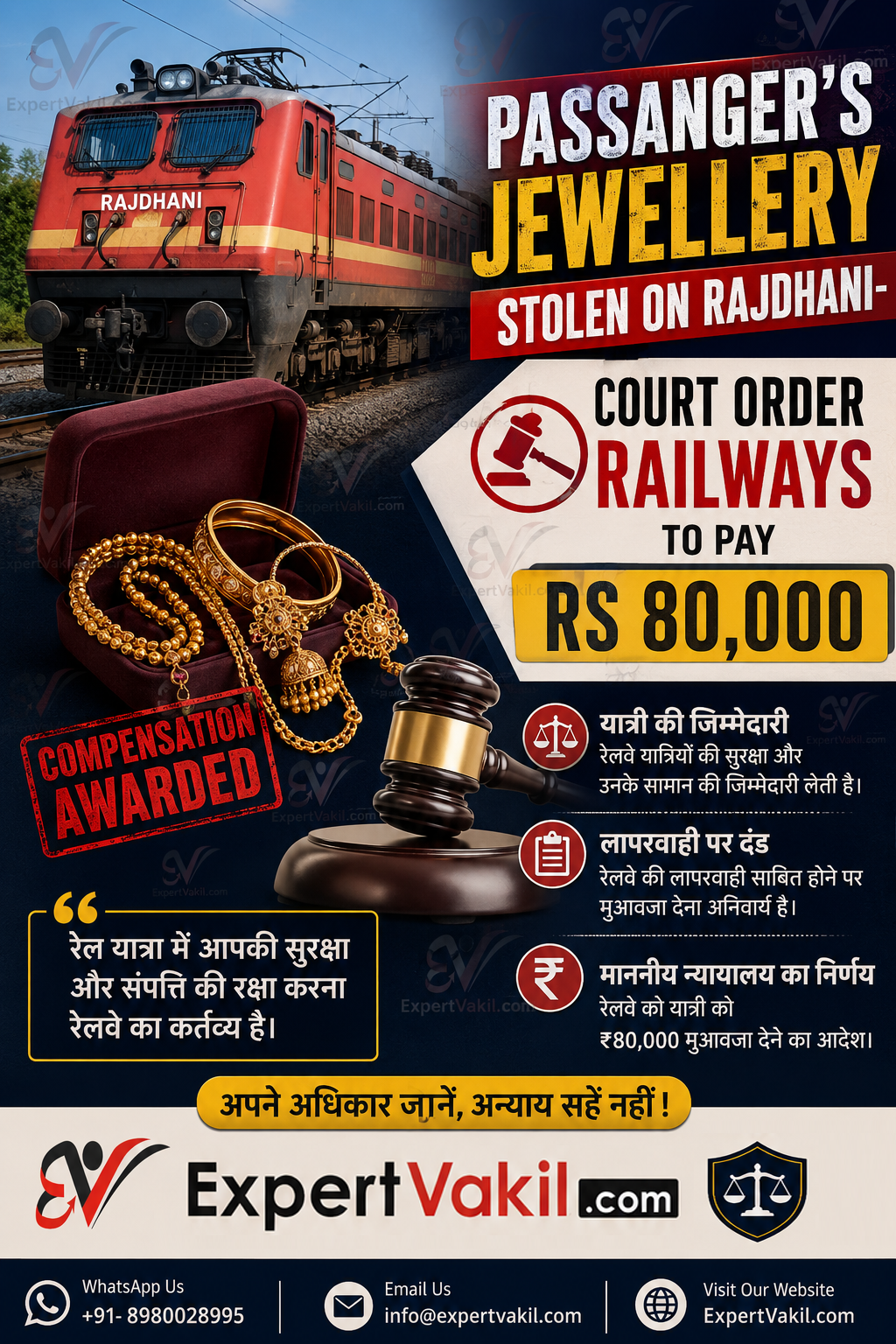
A Punjab consumer commission has directed Northern Railway to pay Rs 80,000 to a couple whose handbag, containing a gold mangalsutra and cash, was allegedly stolen during a journey on the Dibrugarh–New Delhi Rajdhani Express. The ruling is significant because the commission treated the incident not merely as a theft complaint, but as a case of deficiency in service by the Railways.indianexpress+2
Why this case matters
This order matters because it reinforces a basic legal principle: when passengers travel in a reserved coach, they are entitled to a reasonable level of safety, assistance, and accountability from the railway administration. The commission’s finding suggests that where operational lapses contribute to passenger loss, consumer law can step in and award compensation.
For everyday passengers, the ruling sends a wider message. Railway authorities cannot always avoid liability simply by arguing that theft was committed by an unknown third party if surrounding facts indicate negligence, lack of supervision, or failure to provide expected onboard assistance.
What happened on the train
According to reported details, the couple and their child were travelling in a reserved 3AC coach on December 14, 2021, when their handbag was allegedly stolen during the journey. The missing bag reportedly contained a 15-gram gold mangalsutra valued at about Rs 65,000, Rs 5,000 in cash, and a bank passbook.
Reports indicate that the theft occurred while the passengers were asleep and that unauthorised persons allegedly entered the coach. The commission appears to have taken note of the circumstances inside the reserved compartment, especially the issue of passenger assistance and coach-level supervision.economictimes.
What the consumer commission held
The District Consumer Disputes Redressal Commission, Pathankot, Punjab, held Northern Railway guilty of deficiency in service. It then awarded Rs 70,000 for the loss suffered and an additional Rs 10,000 for mental harassment and agony, taking the total compensation to Rs 80,000.
The reported order also states that the compensation would carry 6 percent annual interest from the date of filing of the complaint until realisation. If payment is not made within one month of receipt of the certified copy of the order, the amount would attract 12 percent annual interest on the full sum from the date of filing until actual payment.economictimes.
The legal issue: deficiency in service
At the heart of the dispute was not only the theft itself but whether the Railways failed in their legal duty toward reserved passengers. Consumer forums in India often examine whether a service provider acted with reasonable care, maintained proper systems, and responded adequately when a customer suffered avoidable harm.
In this case, the reported reasoning points to lapses in passenger assistance and weaknesses in the Railways’ defence. That is important because consumer liability often turns on surrounding conduct, such as absence of staff, failure to monitor reserved areas, or inability to explain how unauthorised persons accessed the coach.
What this means for railway passengers
The order is a reminder that passengers may have remedies beyond filing a police complaint. Where loss occurs in circumstances suggesting negligence by railway staff or failure in onboard services, a consumer complaint can become a practical legal route for compensation.
That said, not every theft on a train will automatically result in railway liability. A successful claim usually depends on evidence such as ticket details, proof of valuables, complaint records, prompt reporting, and facts showing that the service provider failed to exercise reasonable care.
Key takeaways for consumers
Passengers who face a similar incident should act quickly and methodically. The legal strength of a case often depends less on outrage and more on documentation.
- Preserve the ticket, PNR, coach and berth details.
- File an immediate complaint with onboard staff, RPF, GRP, or station authorities.
- Keep a written or digital record of when the theft was discovered and whom you informed first.
- Retain bills, valuation records, photographs, or bank documents that help prove the missing items.
- Consider a consumer complaint where facts suggest negligence, poor supervision, or lack of assistance by railway authorities.
Why the ruling has broader impact
This case may influence how passengers, lawyers, and railway officials think about accountability in reserved travel classes. It underlines that consumer protection law can apply to public transport services when paying passengers do not receive the standard of care reasonably expected in the circumstances.
It also highlights an important public law and consumer law overlap in India: railway travel is not just a transport transaction, but a service relationship with enforceable duties. When those duties are breached and the evidence is persuasive, commissions are willing to grant compensation for both actual loss and mental harassment.
ExpertVakil angle
For legal readers, this is more than a human-interest railway theft story. It is a useful example of how consumer jurisprudence continues to expand practical accountability in public-facing services, especially where ordinary citizens face institutional defences after suffering relatively modest but personally serious losses.
For the general public, the lesson is simple: keep proof, report immediately, and do not assume that a theft complaint ends with an FIR. Where railway negligence can be shown, compensation may follow through the consumer law route.